
THE FINAL WORD / EDITORIAL REVIEW
Spiritfarer: Farewell Edition
A moving relationship game when its everyday work becomes part of caring, and departures change the meaning of familiar routines.
Game facts
- Developer
- Thunder Lotus
- Publisher
- Thunder Lotus
- Released
- 18 August 2020
- Platforms
- Windows · macOS · Linux (Steam edition)
- Model
- Paid game
- PEGI
- 12 · Mild Swearing, Sexual Innuendo — Steam UK listing
- Players
- Single-player · Multi-player · Co-op · Shared/Split Screen Co-op
- Length
- Long
- Difficulty
- 2 / 5 · Approachable
- Steam Deck
- Verified
PEGI source ↗ · Steam Deck status source ↗
Edition: Base game
The score, explained
The interest and responsiveness of the core decisions and actions.
How progression, exploration and goals fit together.
The coherence of the visual, musical and narrative presentation.
How clearly the game explains its rules and offers useful ways to engage.
The depth of optional goals, alternative approaches and reasons to return.
A boat becomes a shared home
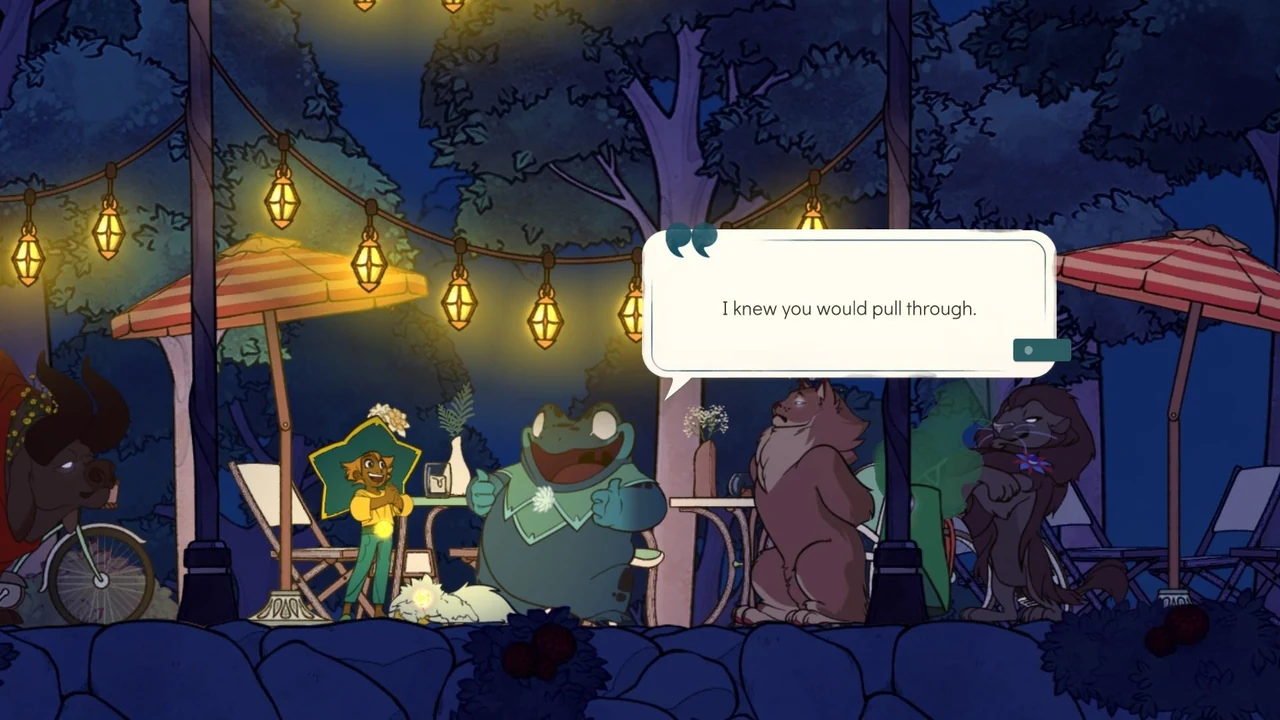
Spiritfarer makes Stella's work both practical and personal. She guides spirits towards a final departure, but first gives them a place to live aboard a boat that gradually becomes a small community. Cabins, gardens, kitchens and workshops turn the vessel into an arrangement of daily needs, making each passenger's presence visible. The early appeal is the connection between care and routine. Cooking a meal or improving a room is not simply a resource transaction when the person receiving it has a recognisable preference and a history to reveal. For Story Path Catalog, this is the central narrative strength. The boat allows relationships to develop through repeated attention, so an ordinary task can become meaningful because of who is waiting for it.
Everyday requests give the passengers a voice
The spirits express themselves through preferences, conversations and the things they ask Stella to do. A favourite food or an awkward request can reveal temperament as effectively as a formal speech. Travelling between islands provides opportunities to gather materials and follow those personal threads, while new abilities open additional routes. The management systems create a steady rhythm around the stories rather than placing them in a separate narrative menu. That arrangement makes departures powerful when a familiar routine suddenly loses the person who gave it meaning. The game does not need every relationship to be equally comfortable or affectionate. Its strongest moments allow care to coexist with frustration, making the passengers feel like people whose needs cannot always be reduced to an easy expression of gratitude.
Care can become a demanding routine
The same repeated tasks that establish attachment can also slow the story. Farming, crafting, cooking and travelling require attention even when the player is most interested in a particular passenger's next conversation. The tone also needs to be understood clearly: the colourful presentation accompanies themes of death, illness and grief rather than removing them. Some relationships are deliberately difficult, and the game does not promise that every departure will feel resolved in the same way. Players looking for a straightforward cosy management game may find that emotional weight surprising. The recommendation is strongest when routine itself can be part of the experience. If repeated production tasks feel like barriers to the characters, the journey may seem more extended than its most affecting scenes require.
Choose it when attention is part of the story
Spiritfarer suits players who want relationships to develop through what they do for people, not only through what they say. The boat gives those relationships a shared physical setting, while the continuing journey makes room for both attachment and departure. Its gentle movement and management systems offer a distinctive alternative to the combat that structures many party adventures. Choose it if you can appreciate a story that gives everyday care time to become familiar before asking what it means to let someone leave. Readers seeking a short, tightly edited narrative should consider the substantial routine around the strongest scenes. The lasting impression comes from a practical absence: a room, a meal or a place on the boat that remains after its passenger has gone.
The verdict
A moving relationship game when its everyday work becomes part of caring, and departures change the meaning of familiar routines.
Reasons to play
- Passengers' preferences make care specific
- The boat gives relationships a shared home
- Difficult personalities add emotional texture
Reasons to think twice
- Crafting and travel can delay personal stories
- Loss and grief remain central despite the gentle art
See the game

Assist & accessibility
Explore the available settings and control options on the official game page before choosing your setup.
Parents’ guide
Players: Single-player · Multi-player · Co-op · Shared/Split Screen Co-op. No in-game purchase marker in the checked Steam listing. Separate downloadable content may be sold.
Age classification: 12. Mild Swearing · Sexual Innuendo Steam UK listing
A useful starting tip
Group several passengers' needs before a journey so that gathering has a clear purpose beyond filling storage.
A different direction
Compare this with Clair Obscur: Expedition 33: A striking party journey whose shared mission gains emotional weight through the different lives carried into it.
Official sources
Reviewed: November 2026
You might also like
 Baldur's Gate 3Read review →
 Clair Obscur: Expedition 33Read review →
 HadesRead review →